Togo Baptist Convention

Our history

About the TBC Our history

From 1919 to today

More than a century of faith and mission in Togo

From a small group of Yoruba believers to a convention of 629 churches: the key milestones in the history of the Togo Baptist Convention.

1919

A small group of Yoruba Christians lays the foundations of the Baptist church in Togo.

1964

On 24 November, the Baptist church is officially recognized in Togo.

1988

Birth of the Togo Baptist Convention, with six associations.

2025

Rev. Elie Kokou Ayadome is elected president on 3 April.

  1. 1919 – 1957

    The beginnings of the Yoruba Baptist church in Togo

    The Baptist church was born in Togo from a small group of Yoruba people who longed for freedom. They were ready to do whatever it took to overcome the challenges of being a minority group and to secure their children's future. Encouraged by the Ghana Baptist Conference (GBC) and inspired by the example of the Methodists, they decided to break away from other Christian groups despite the many conditions and restrictions in force at the time. This was in 1919.

    Later, in 1955, during a visit by Rev. John Idowu, the idea of starting a Baptist church emerged. But they urgently needed a pastor to lead them. Pressed by this need, they accepted a pastor proposed by the association: Pastor Samuel Amao, who took up his post in December 1956. It was not until 14 April 1957 that they were able to form a separate Baptist group.
  2. 1957 – 1959

    The quest for full autonomy

    The Yoruba Baptists were now separate but not yet autonomous. The authorities of the Evangelical Presbyterian Church still kept a watchful eye on the young community. Internally, crises were growing: a group of elders no longer wanted the Ghanaian pastor. In their search for a solution, they contacted the Baptist church in Paris without the pastor's knowledge. The association finally decided to bring the pastor back to Ghana and to send a very experienced pastor from Nigeria — calm returned completely, and the internal difficulties at last found answers.

  3. December 1958

    Progress towards biblical Baptist faith

    In December 1958, the association appointed Pastor Oladejo Owolabi to serve the Yoruba Baptists in French Togo. Under this well-trained man, supported by the association, the mission and the Yoruba community, change soon came. With the help of the Southern Baptist Mission and the Nigerian Baptist Convention, the new pastor worked to establish biblical principles in the community, reorganizing the church along the lines of Southern Baptist churches.

  4. 1959 – 1964

    Organizing the church and calling on Southern Baptist missionaries

    In 1959, the Paris Protestant Mission left Togo for good, releasing the Evangelical Presbyterian Church and all the other Protestant missions. An appeal to evangelize Togo was sent to the Southern Baptist Mission. The missionary couple Clayton Bond, who had been interested in Togo since arriving in Ghana in September 1958, were assigned to Togo and arrived on 1 October 1964, after French language training.

  5. 1964

    Problems resurface

    After the missionary couple left, tensions resurfaced. The elders who had celebrated Pastor Samuel Amao's departure had already grown tired of the new pastor, who had set them aside as polygamists ineligible for leadership positions. Tension between the pro-evangelical elders and the new converts to Baptist faith became very high, and everyone waited for the missionary couple to return and settle the matter.

  6. October 1964

    The division of the organized church

    The missionary couple returned on 1 October 1964 and were immediately confronted with the crisis. Fearing that the government might close the church while it awaited official recognition, the situation was resolved on 25 October: the church split, with the young people leaving to form their own church — barely a month before the church was officially recognized by the Togolese State.

  7. 24 November 1964

    Official recognition of the Baptist church in Togo

    On 24 November 1964, the official decision was issued: the Baptist Church Association was recognized in Togo, covering all Baptist initiatives in the country — the Yoruba Baptists, the first converts of the missionaries, ABWE (Association of Baptists for World Evangelism) and the beginnings of the Full Gospel Baptists. It was a long-prepared missionary project, despite repeated closures of the border with Ghana since Ghanaian independence in 1957.

  8. October 1964

    Arrangements for the ministry

    On 5 October 1964, the missionary couple and Pastor Oladejo Owolabi had long discussions about the direction of the ministry, insisting that they would work with all Togolese people and not only with the Yoruba. A welcome service was held for the missionary couple on 11 October, and the two groups that emerged from the split remained covered by the same recognition document.

  9. 1964 – 1965

    The Yoruba Baptists as members of the Ghana Baptist Conference

    The Yoruba Baptists remained members of the Ghana Baptist Conference until the end of 1964. That year, missionary Bond, now settled in Togo, called for the Lomé-Keta association to be dissolved: the Baptist Association of Togo became free and belonged entirely to French Togo. In 1965, a reconciliation formed the Ebenezer Baptist Association, marking the true beginning of the Yoruba Baptist church in Togo.

  10. 1964 – 1986

    The beginnings of the Evangelical Baptist churches of Togo

    The Evangelical Baptist church of Togo — today's TBC — began in 1964. Between 1964 and 1986, Togolese people were evangelized, churches were planted and associations multiplied: the Ebenezer Association in 1965, then the Association of Ewe churches in 1973. In 1978, the Togolese government closed unregistered churches, which led the Yoruba and Ewe associations to merge into a single Association of Baptists in Togo (ABT). Evangelism then continued towards the north of the country.

  11. 1988 – 2025

    The birth of the Togo Baptist Convention and its growth

    Faced with the travel costs of delegates from the north, the division of the associations was launched at a meeting in Kouvé in 1984. Between 1984 and 1988, a study was carried out and a constitution drafted. On 24, 25 and 26 March 1988, the Togo Baptist Convention (TBC) was born at the Boulevard Baptist Church, with six associations: A (Bethel), B (Agapé), C (Zion), D (Truth), E (The Way), F (Northern Association, later renamed Light, from Blitta to Dapaong). In 1989, the Baptist Mission officially left Togo, but leadership remained in the hands of expatriates until 2002, when the last missionary left the Baptist centre in Morétan. Deacon Koudakpo Komlan was the first African leader (general secretary from 1991). Since then, the following have served in turn: Deacon Oke, Kwashie Amenudzie, Joseph Adjenou, Jean Sodehoudji, Bamerbanona Kadera, Remy A. Agossou, Pierre Ayawo Adossi, and the current President, Rev. Elie Kokou Ayadome, elected on 3 April 2025. Today, the TBC has nearly 55,000 members worshipping in at least 629 churches, organized into 17 church zones and eight national departments: Ministers of the Gospel and Theological Training, Church Development, Mission-Evangelism, Men's Missionary Union, Women's Missionary Union, Youth-Sport-Leisure, Children's Development, and Projects and Schools.

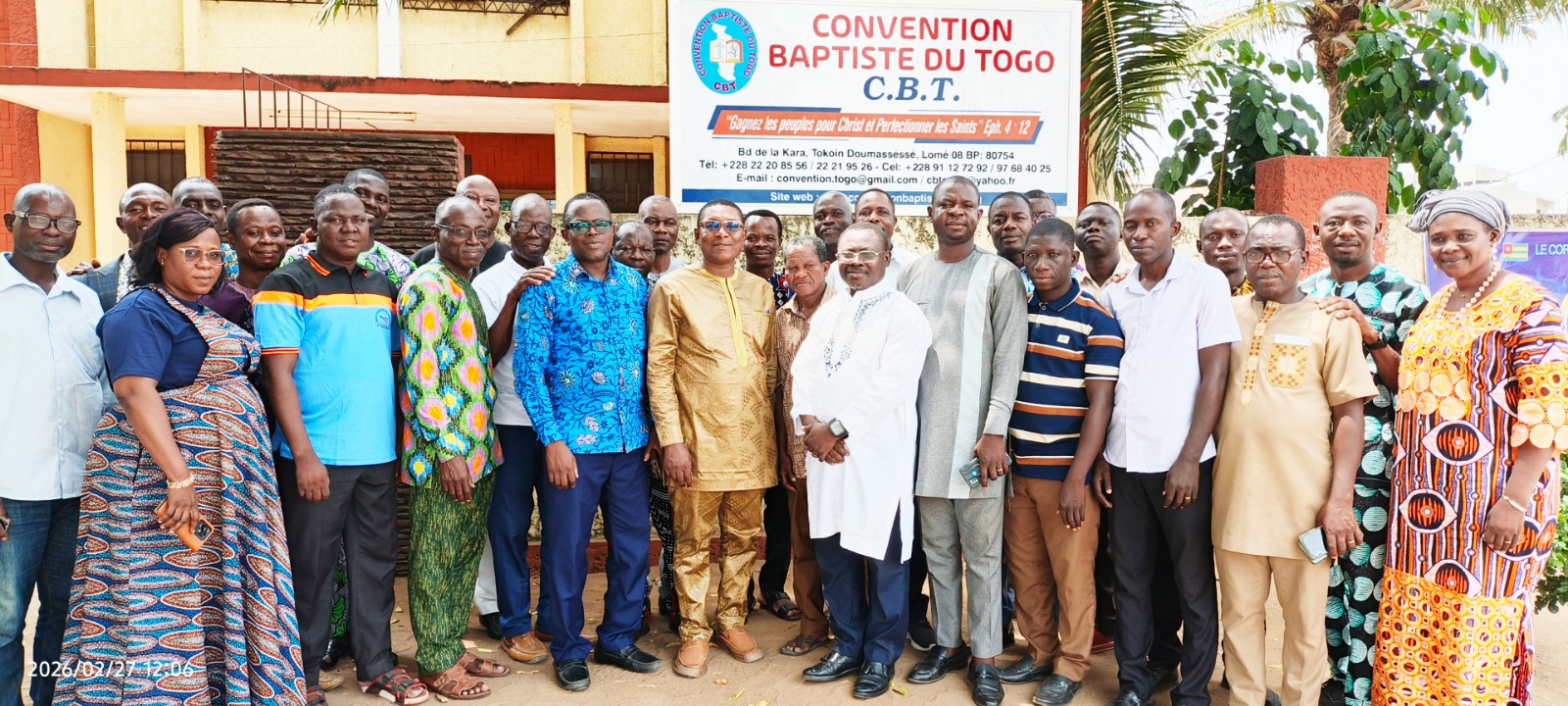
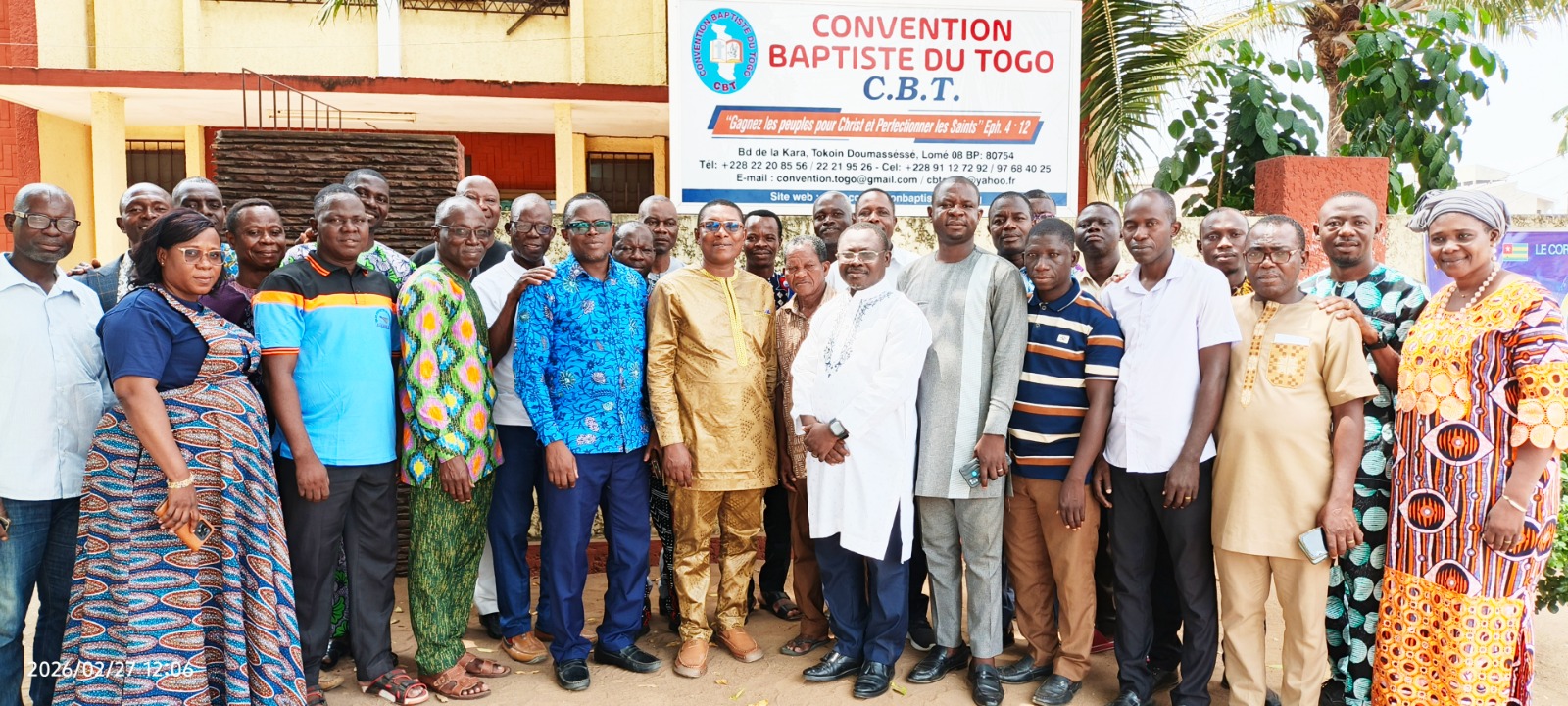
TBC leaders in front of the headquarters in Lomé

Today

The TBC today

55 000

members (approx.)

629

local churches

17

church zones

8

national departments